They interrupted their courses to rush to the rescue – firefighters from Kiambu in action.
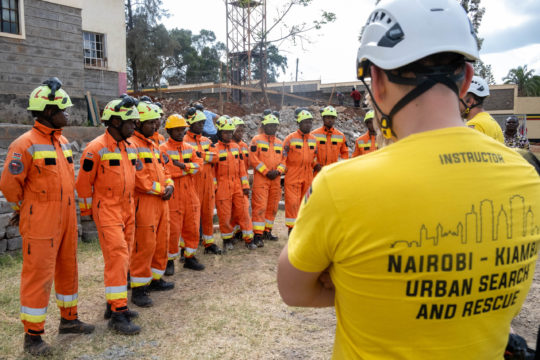
On 1 December, a group of firefighters in Kiambu were preparing for another training session, this time in the classroom after several weeks of intensive field drills. Their plans changed instantly when the station alarm sounded: a building in Nairobi had collapsed with four people inside. Just two years ago, Kenya had no specialist team capable of responding to such an incident. Today, even though the newly formed unit is still in training, it remains on constant standby and deploys as soon as a call for help comes in.
A wide elevated highway cuts through the heart of Kenya’s capital, making a striking impression at night when the darkness is pierced by harsh neon lights. Nairobi, often called the “New York of Africa”, has earned this nickname with its skyline and busy arteries, yet behind the high‑rises and crowded streets lies another reality: uncontrolled urban growth.

Nairobi has been expanding at a breathtaking pace, growing from around 3.1 million inhabitants in 2009 to about 4.4 million in 2019, with projections suggesting up to 5.6 million residents by 2025. This rapid increase, combined with a shortage of affordable formal housing, fuels the growth of informal settlements and ever‑denser construction, including ad‑hoc additional floors, which in turn raises the risk of structural failures. The same trend is visible across Kenya, with UN agencies and the World Bank noting a fast‑accelerating shift of people from rural to urban areas.
Beginings
The building boom can be seen not only in Nairobi itself. Kiambu, where the Polish Center for International Aid’s training centre is located, is now practically fused with the capital, to the point where the boundary between the two is difficult to spot. As instructor Konrad Szymkiewicz recalls, ten years ago, this training ground and its surroundings looked entirely different, with none of the buildings that stand there today, and the urbanisation processes visible in Nairobi are clearly evident here as well.
Rapid expansion is not only visible in Nairobi. Kiambu, where the training center built by the Polish Center for International Aid is located, is almost adjacent to Nairobi. It is impossible to distinguish where the border between these cities lies. Especially since urbanization is progressing at a rapid pace here.
“Ten years ago, this place looked completely different. None of the buildings we see here existed,” says Konrad Szymkiewicz, an instructor, pointing to the training ground buildings. However, it is not only the “Fire Track” that has changed its appearance, but also Kiambu. The processes that are visible in Nairobi are just as noticeable here.
The Polish foundation has been supporting the Kenyan fire service continuously since 2014. Over the decade, the number of firefighters across the country has increased from around 450 to over 1,500, with Kenya’s population standing at around 55 million. One of the results of PCPM’s activities is the establishment of the Fire and Rescue Training Center in Kiambu in 2018-2020, where about 60% of all fire department personnel in Kenya have been trained.
“When we started, we could only count on ourselves. We lacked equipment for both training and everyday work. Now it looks completely different. Kenyan firefighters are better trained, they have equipment, and there are more of them. Of course, there is still a lot to do, but the progress is enormous,” recalls Szymkiewicz.
Continuous development
The 10-year project is undoubtedly a success, but the scale of the challenges remains enormous. 1,500 firefighters for the whole of Kenya is definitely not enough to deal with all the challenges. In Poland, which is half the size of Kenya and has almost half the population, there are over 30,000 professional firefighters and 700,000 volunteers from the Volunteer Fire Department.
“We have only six fire stations in Nairobi, and the one we are in was built in 1906,” says the firefighter, pointing to the tower in the center of the unit. At that time, it was the tallest building in Nairobi, but now it disappears in the thicket of tall buildings in the capital.
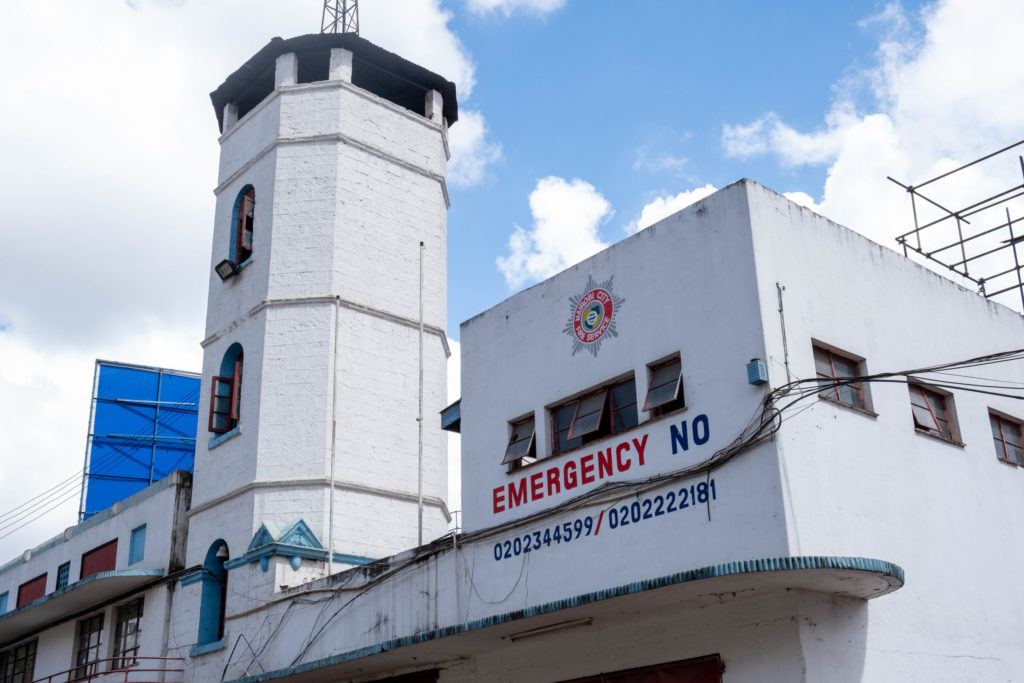
“As you can see, the traditions are very old, but further investments have not followed. This year (the fiscal year in Kenya runs from June to June), we plan to commission three more fire stations, but that will still not be enough for such a huge city,” explains the firefighter from Nairobi.
“Unfortunately, we can’t be everywhere,” says Gedion Owiti, “and I have the impression that there are more and more tasks. Unfortunately, numerous collapses are becoming more and more frequent, which is why we are so grateful to Poland for giving us equipment, but above all, knowledge.”
First USAR in Kenya
“Now Kenyan firefighters are ready for training. They know how to extinguish fires, how to help during accidents, and most importantly, after 10 years, they can do it all themselves. If we pack up and leave now, everything will stay here and they will be able to continue training on their own and, most importantly, help others,” says the Polish instructor.
According to representatives of the foundation, the latest phase of the project in Kenya is a natural step in the whole process. PCPM’s work began with the creation of a staff and a system to transform the fire department from the ground up. The next step was to systematize and create an official training process that every firefighter would undergo.
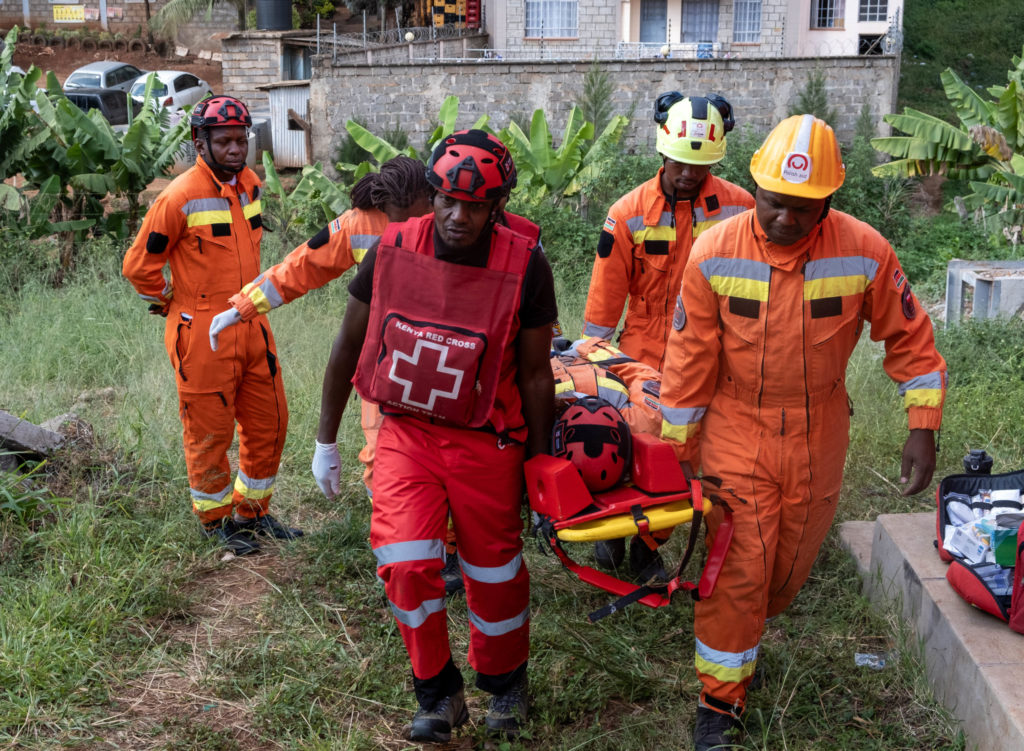
“Since 2024, we have been building a search and rescue team (USAR),” says Rafał Własinowicz, chief instructor. “Unfortunately, many buildings, especially in Nairobi, are built with poor materials, often without any supervision. Not a month goes by without a disaster. In Poland, there may be two accidents a year, but here in Nairobi alone, not a month goes by without a disaster,” explains the Polish firefighter.
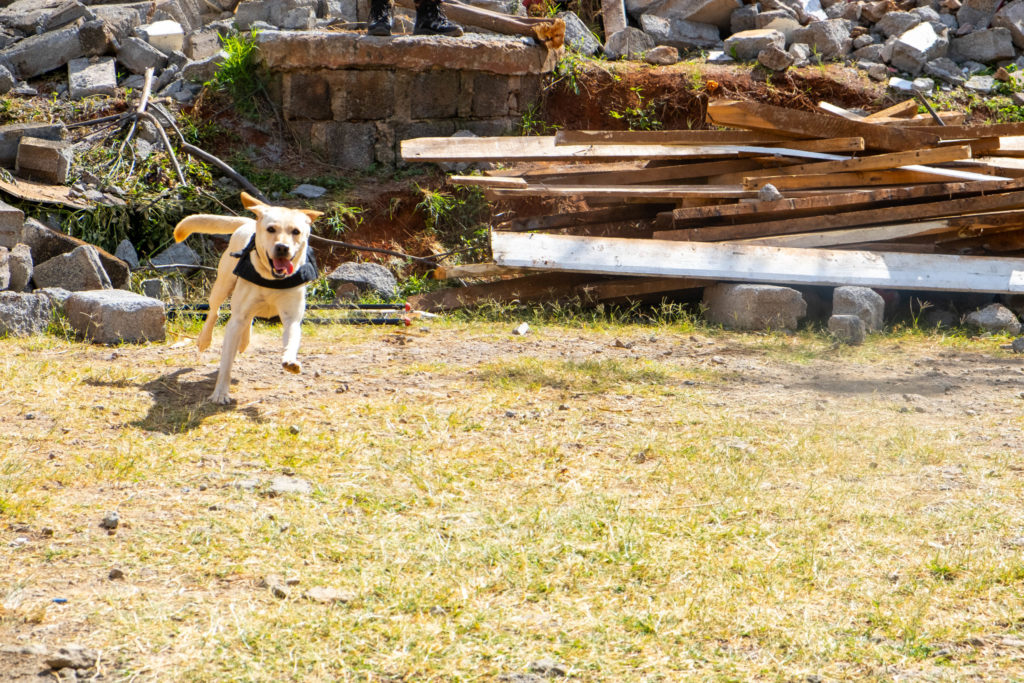
The training has been going on for two years and has now entered its decisive phase. As usual, the training ground in Kiambu is crowded, but this time, in addition to numerous firefighters and instructors, they are joined by uniformed officers and two extraordinary veterans, Shanty and Jerry. They are tracking dogs trained to search for victims under rubble. Only the army has such animals in Kenya, but the USAR team must know all the secrets of search and rescue work.

“These exercises are extremely important both for us, as the coordinating unit, and for the USAR team. This is the first training of its kind ever organized for a civilian rescue unit,” says Ronald Asava of the National Disaster Operations Center.
“The specific nature of the USAR team’s work is to search for people who are trapped in a given location. However, as a rule, such people are not visible and must be found as quickly as possible, and time, as in any rescue operation, plays the most important role. The USAR team is equipped with a range of tools that allow us to locate such people, but rescue dogs can find a person hidden under the rubble much faster,” says Ronald Asava.
Why is training with dogs so important if the team itself will not have such dogs?
The team of firefighters must be able to work with such dogs, especially since they will not have such animals at their disposal. This will significantly improve their performance. We have trained over 70 firefighters, and at this point, I can say that they are ready. We still have a year of training ahead of us, but our firefighters are already gaining experience, because unfortunately, incidents where such a team is needed are frequent in Kenya,” concludes Ronald Asava.
From training to action
Unfortunately, these words proved prophetic, as another tragedy occurred on December 1. In Nairobi, a building constructed from poor-quality materials collapsed under its weight. Firefighters abandoned the lecture hall where they were attending theoretical classes and rushed to the scene. They were accompanied by Polish instructors, who provided them with technical support. Two people managed to save their lives, but unfortunately, two others died.
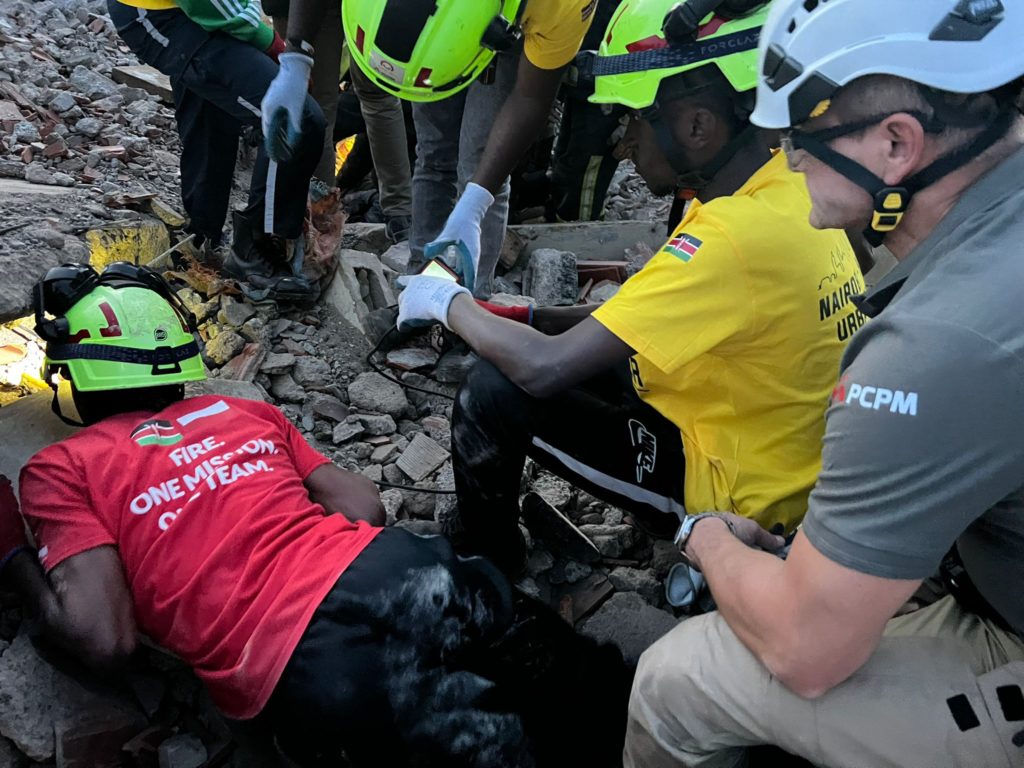
According to witnesses, the building collapsed like a house of cards because the ceilings were made of poor-quality materials. Unfortunately, in such cases, the chances of finding survivors in the rubble are very slim. Firefighters from Kiambu also worked through the night to confirm that there were no more victims. Unfortunately, this is not the first such accident in Nairobi, and there are many indications that there will be more.
“Thanks to PCPM, we can help when a building collapses. Two years ago, we wouldn’t have known what to do,” says firefighter Gedion Owiti. “Unfortunately, there will be more accidents like this, but we will be ready,” he adds.
The PCPM Foundation project is funded under the Polish Aid program of the Ministry of Foreign Affairs of the Republic of Poland.