The USAR team in Kenya has saved 14 lives
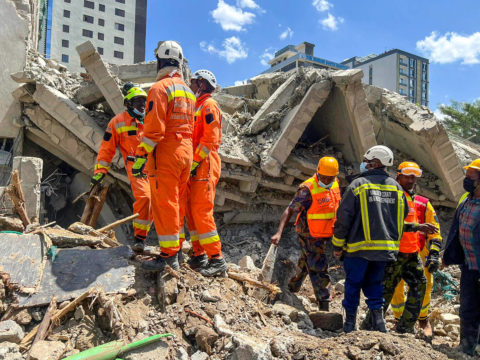
“I prayed, because that was all I had left when the well collapsed on me,” recalls Robert, who was pulled out of a buried well after 14 hours. He is one of fourteen people rescued by USAR firefighters since the beginning of the year.
“At first, there was a sound, as if something had cracked deep inside the wall. Then everything started to crumble,” says one of the witnesses of the collapsed building in the South C estate in Nairobi. He points to the spot where a multi-story building stood not long ago. Today, there is only a pile of rubble and twisted steel bars. Stories like this in this part of the city are not uncommon – they are part of everyday life.
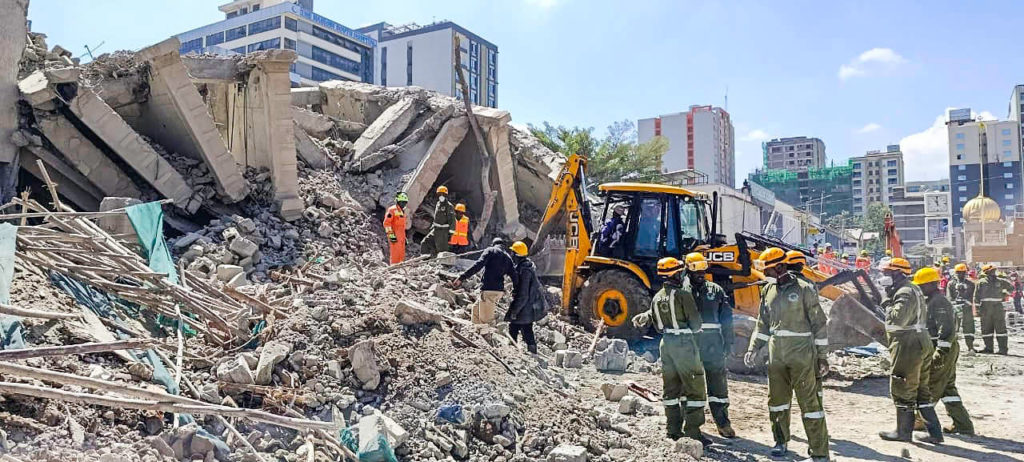
It is in this reality that the Kenyan Urban Search and Rescue (USAR) team operates, trained by the Polish Center for International Aid under the Polish Aid program. Since the beginning of the year, its members have saved fourteen people.
“Collapses are common, and there are several each month. In Poland, these are literally isolated incidents,” says Rafał Własinowicz, a firefighter and PCPM instructor in Kenya. “Since 2024, we have been building a search and rescue team (USAR). Unfortunately, many buildings, especially in Nairobi, are constructed using poor-quality materials, often without any supervision. There isn’t a single month without a disaster. In Poland, there might be two such incidents a year, while here in Nairobi alone there is not a month without one,” the Polish firefighter explains.
“We cannot be everywhere,” says Gedion Owiti, a Kenyan firefighter, “and I feel like the number of tasks keeps growing. Unfortunately, collapses are becoming more frequent, which is why we are so grateful to Poland – not only for the equipment, but above all for the knowledge.”
“The water was covering my face”
Collapses during excavation works are also common. Robert Makoha was one of the workers buried while constructing a well in Ruaka.
“It was an ordinary day. I woke up and went to work as usual. I went down into the well, where I was removing soil and cleaning it from the inside to keep it stable. When I was at the bottom, suddenly several concrete rings – about eight of them – collapsed and fell. I got trapped at the bottom,” Robert recalls.
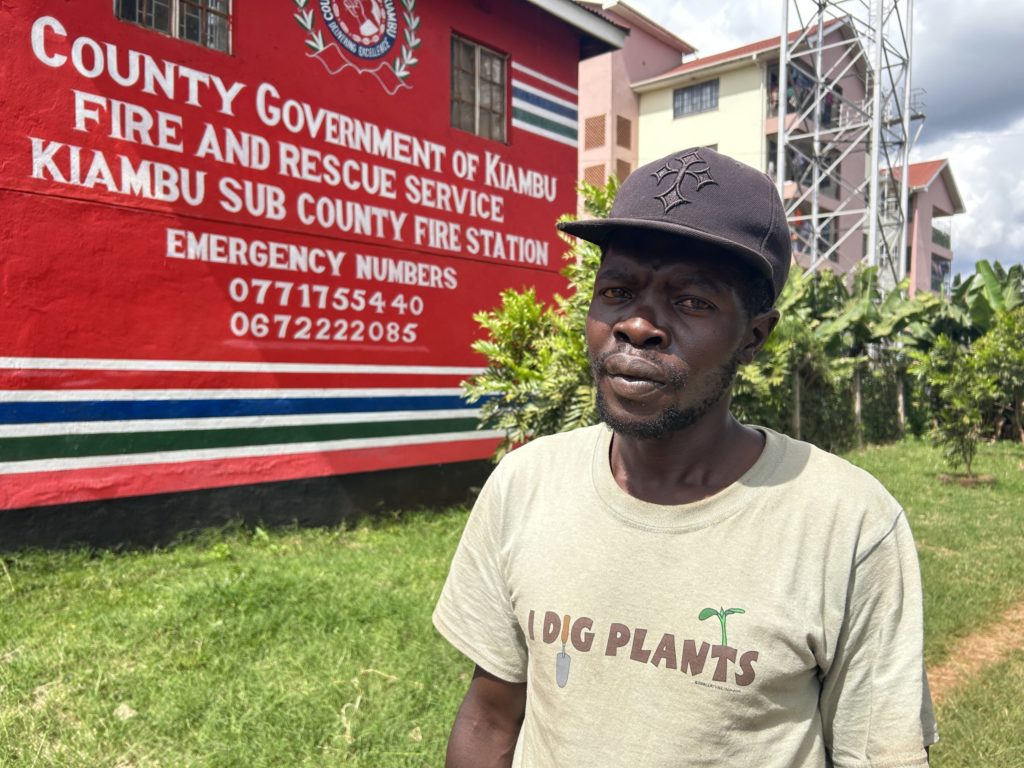
Before firefighters arrived, those present tried to act on their own, using available tools and improvised methods. They used construction equipment and attempted to ensure an air supply, which they eventually managed to do.
For a long time, emergency services were not called – not due to a lack of need, but for practical reasons: no one knew the emergency number. Eventually, one person ran to a fire station about two kilometers away, and that is how the incident was reported. The whole situation differed from a standard emergency response.
“A young man ran to us and informed us about the accident,” recalls firefighter Munyalu. “We immediately took our equipment and went to the scene. We quickly realized it wouldn’t be easy. The well was narrow and surrounded by buildings, which made access difficult. The collapsed concrete rings were very heavy – each one had to be secured and lifted individually using a crane. This required precision to avoid another collapse. Robert was trapped deep in a confined and unstable space, with water at the bottom,” Munyalu explains.
“I was very cold and couldn’t move,” Robert recalls. Worse still, the water was slowly but steadily rising. The well was in complete darkness. “I could hear sounds of work from above, but I didn’t know what was happening. By the time they finally pulled me out, the water had already reached my neck,” says Robert, who still cannot forget the traumatic experience.
As the rescuer recalls, the entire operation lasted 14 hours. “Fortunately, he had no fractures, but he was very weak and showed signs of hypothermia.”
“If it hadn’t been for the rope rescue training provided by the Polish Center for International Aid, we would not have been able to save Robert,” Munyalu adds.
A new life
Robert spent a week in the hospital, and after being discharged, he returned to his hometown.
“Before the accident, as is often the case in Kenya, you take whatever job you can – ‘no work, no food.’ Now I can’t imagine going back to that kind of work,” Robert says.
Today, he works on a farm in his home area.
Nairobi is growing at a pace that outstrips planning. According to UN-Habitat data, as many as 60 percent of the city’s residents live in informal settlements, where buildings are constructed without supervision and often with low-quality materials. Kenyan media and NGOs have been warning for years about recurring construction disasters – only in recent years, building collapses in the country have claimed dozens of lives and…