

Poles are training Ukrainian firefighters. “A very valuable lesson”
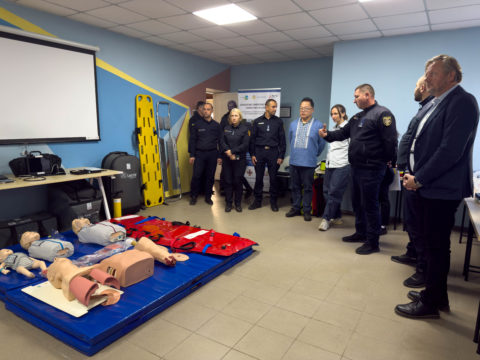
Firefighters travel to the training sessions from regions where air raid alerts are part of everyday life. They have a few days to focus on learning and take a break from the front line.
At a training ground operated by Ukraine’s State Emergency Service (DSNS), participants practise scenarios nobody would ever want to witness in real life. A mass-casualty incident unfolds: there are numerous casualties and very little time. The trainees know these situations from their own experience, as they serve in frontline units on a daily basis.
Training there is no time for
Since 2022, Ukraine has been fighting off Russia’s full-scale invasion. DSNS firefighters have long been doing far more than putting out fires. They carry out technical rescues under fire, deal with unexploded ordnance and pull people from beneath rubble. They themselves are also targeted in attacks. Since the beginning of the full-scale invasion, more than 100 DSNS personnel have been killed and 430 injured.
Under these circumstances, there is neither enough staff nor enough time for training.
“There is a high turnover of personnel, a shortage of people who could train others, and a lack of free time and resources that could be devoted to training in pre-hospital care or mass-casualty incident response,” says Paweł Jessa, project coordinator at the Polish Center for International Aid (PCPM). “We stepped in to help.”
The project, implemented by PCPM with support from Taiwan’s International Cooperation and Development Fund (TaiwanICDF), was launched in late 2025. The implementation phase, including the training sessions, began in May. Over 13 weeks, nearly 300 DSNS firefighters and medical personnel completed courses delivered by 25 instructors from the PCPM Emergency Medical Team and Ukraine.
The principle is simple: first responders from frontline regions travel to safer areas in central Ukraine, where they can receive training without interrupting their operational duties. The organisers call this the safe-haven training model.
Theory takes a back seat
Each course lasts five days. The first day is devoted to getting to know one another and discussing the skills and procedures the participants bring with them. This is followed by four and a half days of training, with each course concluding with an examination and a certificate.
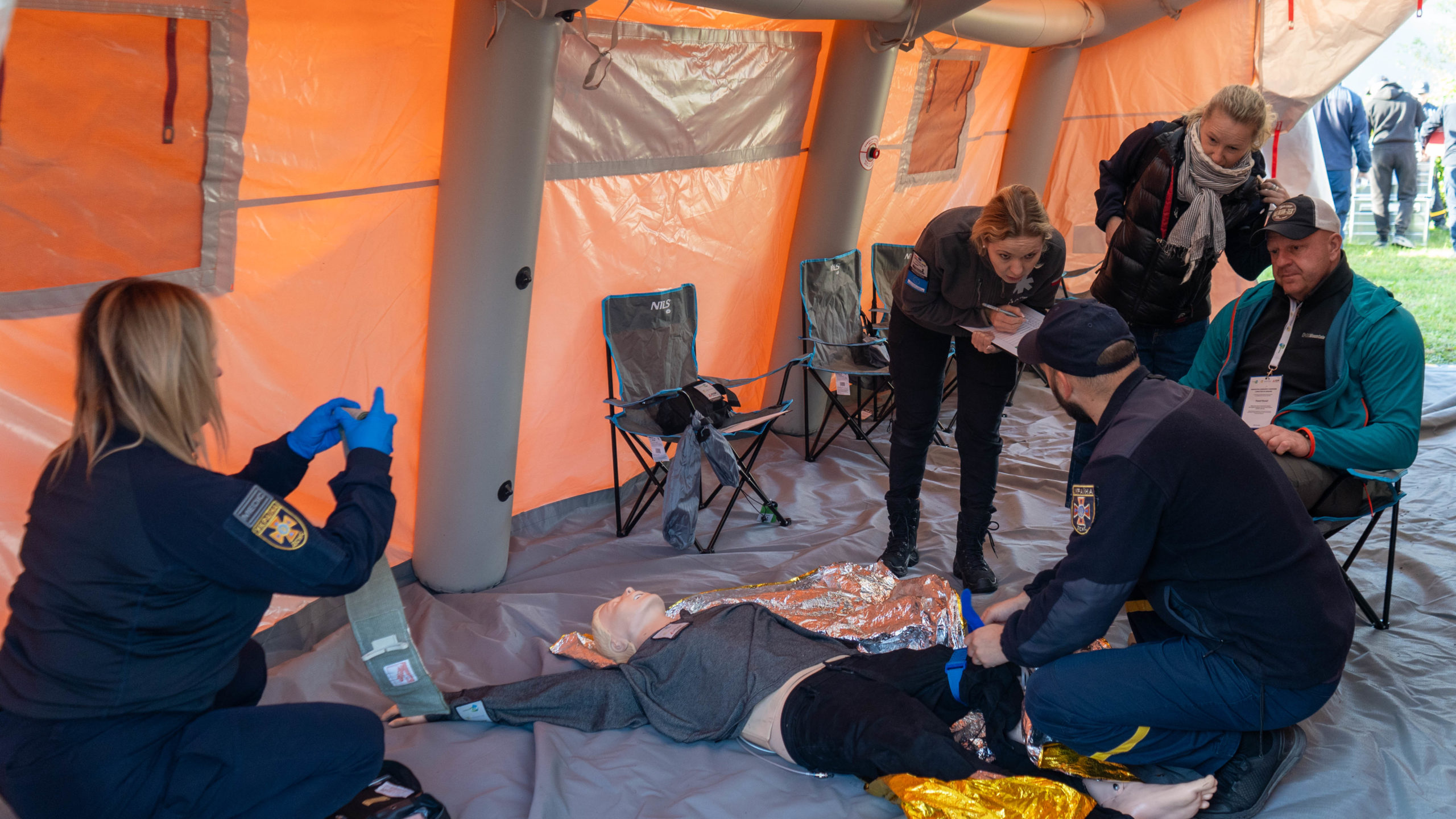
“There is a theoretical module, but we placed the greatest emphasis on practical exercises and workshops, focusing on skills that are urgently needed in the field,” explains Bartek Trzaska, one of the instructors. The courses were delivered by Polish trainers working alongside Ukrainian partners who had gained experience internationally, some of them also during the war.
The instructors wanted to avoid the traditional format in which one person passes on knowledge to everyone else. The participants often have extensive experience of their own and possess unique skills.
“Every region operates differently and has its own experience. It is important for firefighter-medics to share the procedures they have developed,” says Trzaska.
They rarely get the opportunity to do so. They are either working under fire or constantly on duty, with no chance to meet and discuss what works in practice. The training course provided a space for exactly that.
A chance to catch their breath
The courses brought together firefighters and medical personnel from units in the Kharkiv, Kherson, Sumy, Zhytomyr and Mykolaiv regions. For them, the training also offered a chance to recover from the demands of their daily work, during which they are exposed to constant shelling.
“Beyond the exercises and the opportunity to improve their skills, this is also a period of respite from the hardships of working on the front line,” says Jessa. “In a more peaceful environment, they can learn new things and refine skills that they will later put to use in their everyday work.”
“We were surprised that the protocols had changed”
Serhii comes from Vinnytsia and attended the course as a firefighter from a local unit. His assessment is unequivocal.
“The course is good. We learned a lot,” he says.
He particularly appreciated the large number of practical sessions, especially those involving manikins. The trainees practised realistic scenarios that, in his view, would prove useful in their day-to-day work.
He was surprised to learn that the instructors were teaching updated protocols introduced over the past year in line with the guidelines of the resuscitation council. Ukrainian firefighters were not yet familiar with these changes, particularly those concerning paediatric resuscitation.
Asked what else they need, he points to more tactical medicine training, given that the country is at war, as well as more practical scenarios and more hands-on exercises.
Tents that double as warming shelters
According to Jessa, the project goes beyond training. PCPM has purchased dual-purpose equipment. For DSNS, this includes medical simulators and manikins to equip a new training centre. Ten units whose representatives took part in the courses have also received mass-casualty response kits. These include inflatable tents, generators, heaters, lighting equipment, vacuum mattresses and specialised rescue backpacks.
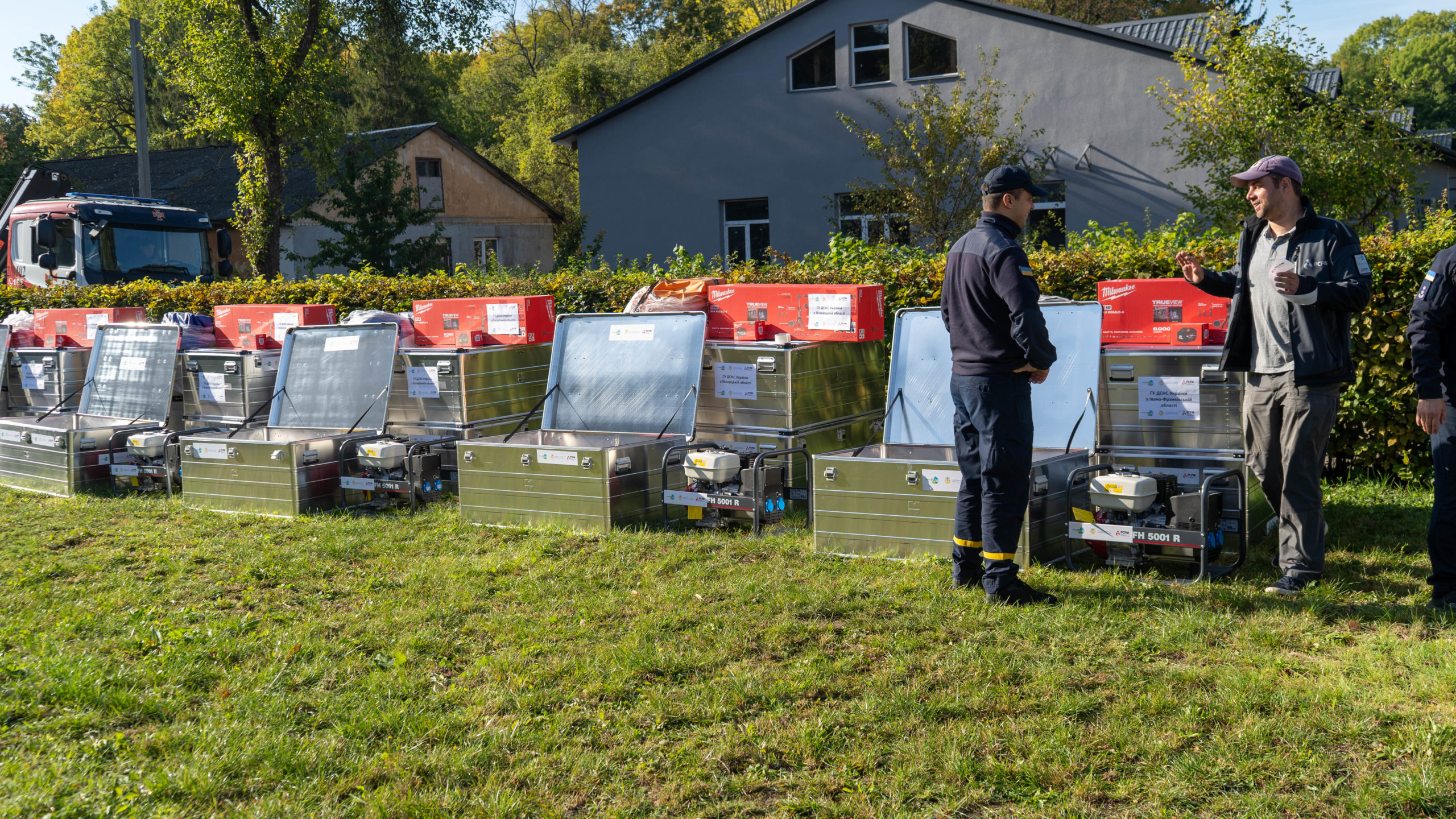
Mykola, another participant, talks about the equipment. The tents are particularly useful because they can serve several purposes at once. When a building has no electricity or heating, they can be used as temporary warming shelters for casualties. They can also be colour-coded, making them suitable for medical triage.
“Above all, what we need right now is a way to warm people up,” he says.
Russian attacks have targeted energy infrastructure that supplies heat. While damaged systems are being repaired, people can come to the tents to warm up.
Equipment and expertise that will remain
What matters most, however, is what will happen after the project ends.
Until now, DSNS personnel have received first-aid training with the help of emergency medical services. The new training centre is intended to be the first step towards establishing similar facilities in other regions. The first instructors have already been trained and will pass their knowledge on to their DSNS colleagues. Of the nearly 300 participants, 24 were selected to complete an advanced course.
“This is a step towards DSNS becoming self-sufficient in providing training in pre-hospital medical care,” says Jessa.
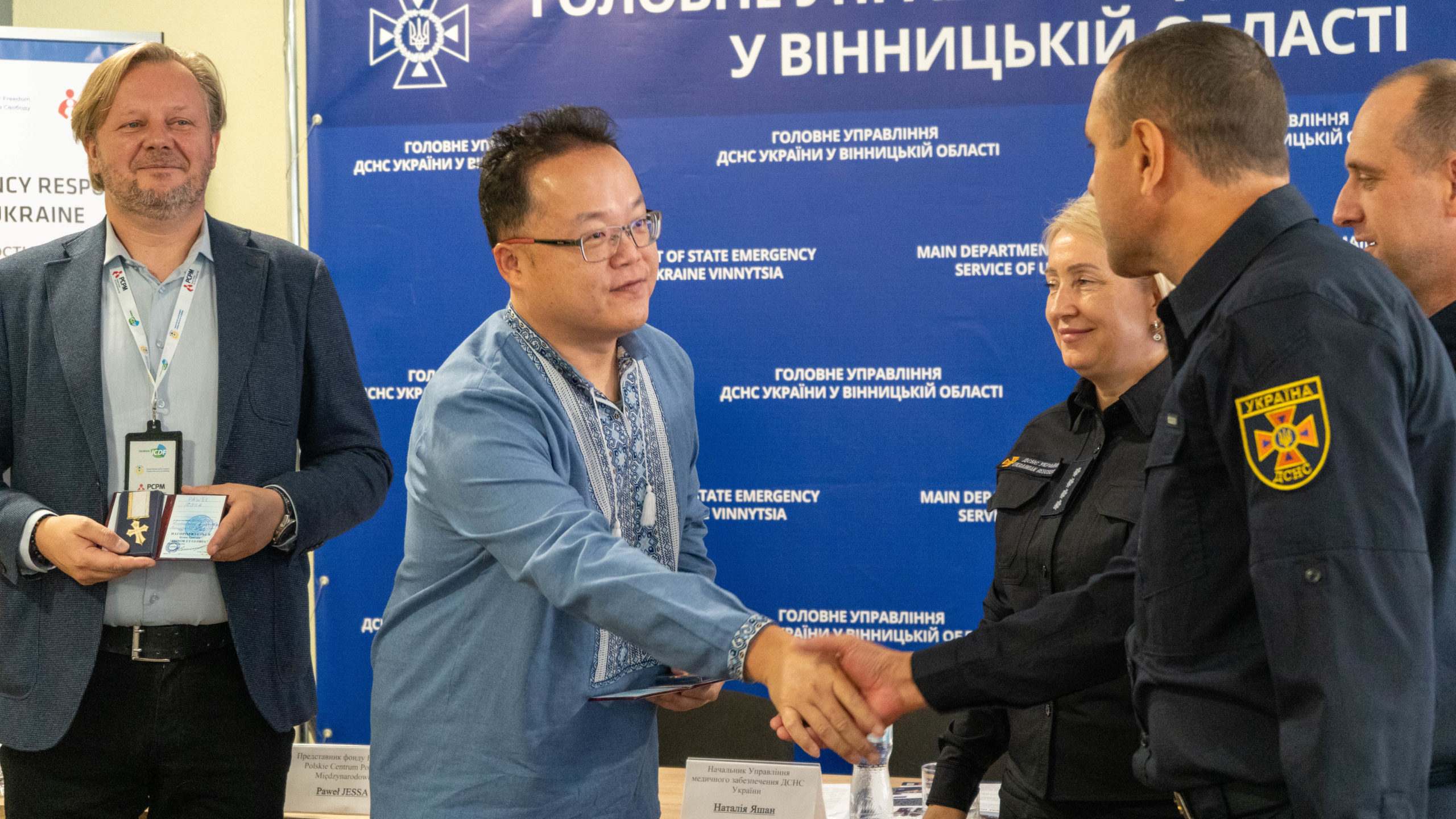
“We have been helping Ukraine for years because we understood long ago that the war would not end quickly. It gives me enormous satisfaction to see the tremendous results of this project after a year and a half,” says Lin Jian-Jhang of TaiwanICDF. “We chose PCPM because of its extensive experience in implementing projects of this kind,” he adds.
“Cooperation between TaiwanICDF, DSNS and PCPM has been excellent. We have achieved a great deal, and thanks to the training courses and the new training centre, a service that Ukraine needs so desperately now has new opportunities,” says Nataliia Yashyn, medical director at DSNS.
She emphasises how grateful she is for the support. Emergency services are under enormous strain, and every contribution of this kind is invaluable. It helps them continue their work while also showing Ukraine that it is not alone.
Each group attends a five-day training course that concludes with an examination and a certificate of completion. For the participants, these days offered not only an opportunity to learn but also a much-needed respite.
The 25 Ukrainian firefighters in one of the groups returned to their home units the very next day. They were heading back to a reality in which they face not only fires but also bombs, missiles and drones.
Every new skill acquired during the training increases the chances of survival for the next people who will inevitably need rescuing for as long as the war continues. Ukrainians are counting on these first responders and their skills. They are the last line of defence for those whose lives depend on their ability to act.


